
Nearly 2 in 3 patients taking Omvoh achieved clinical response at Week 121
63% of patients taking Omvoh achieved clinical response after 12 weeks of induction dosing, and nearly 1 in 4 achieved clinical remission.
Clinical Responsea and Clinical Remissionb at Week 121
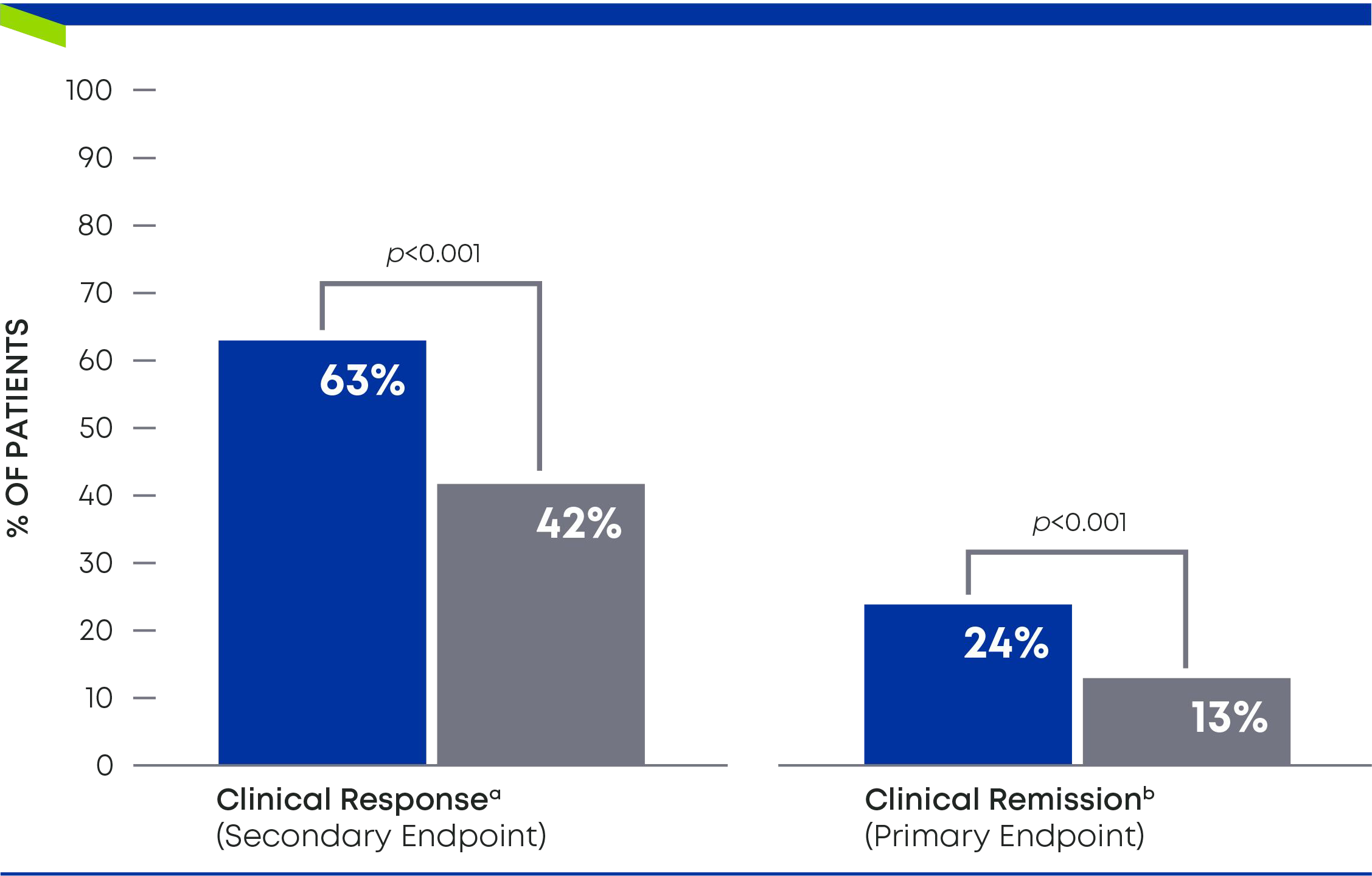
- aClinical response at Week 12 was defined as ≥2-point and ≥30% decrease in the MMS from baseline; RB subscore=0 or 1, or a ≥1-point decrease from baseline.1
- bClinical remission at Week 12 was defined as SF subscore=0, or SF subscore=1 with a ≥1-point decrease from baseline; RB subscore=0; ES=0 or 1 (excluding friability).
MMS=Modified Mayo Score; RB=Rectal Bleeding; ES=Endoscopic Subscore; SF=Stool Frequency
1. Omvoh EUSPC FEB 2025.
Among patients who achieved clinical response* with Omvoh at Week 121
Omvoh demonstrated sustained clinical remission and mucosal healing at Week 521
Week 52 Endpoints1
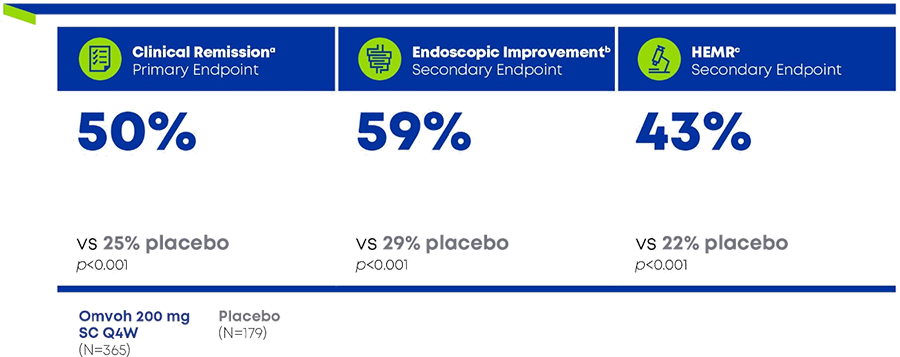
*Clinical response at Week 12 was defined as ≥2-point and ≥30% decrease in the MMS from baseline; RB subscore=0 or 1, or a ≥1-point decrease from baseline.1
Post Hoc Analysis1,2

52 weeks of continuous treatment includes the 12-week induction study (LUCENT-1) plus the 40-week maintenance study (LUCENT-2).2
- aClinical remission was based on the MMS and was defined as: SF subscore=0 or 1 with a ≥1-point decrease from baseline, RB subscore=0, and ES=0 or 1 (excluding friability).1
- bEndoscopic improvement was defined as ES=0 or 1 (excluding friability).1
- cHEMR was defined as achieving both: 1. Histologic remission, defined as Geboes subscores of 0 for grades: 2b (lamina propria neutrophils), 3 (neutrophils in epithelium), 4 (crypt destruction), and 5 (erosion or ulceration); and 2. Mayo endoscopic score 0 or 1 (excluding friability)1
ES=Endoscopic Subscore; HEMR=Histologic-endoscopic Mucosal Remission; MMS=Modified Mayo Score; Q4W=Every 4 Weeks; RB=Rectal Bleeding; SC=Subcutaneous; SF=Stool Frequency
1. Omvoh EUSPC FEB 2025. 2. D'Haens G, Dubinsky M, Kobayashi T, et al. Mirikizumab as induction and maintenance therapy for ulcerative colitis. N Engl J Med.2023;388(26):2444–2455. doi:10.1056/NEJMoa2207940.
Among patients who achieved clinical response* with Omvoh at Week 121
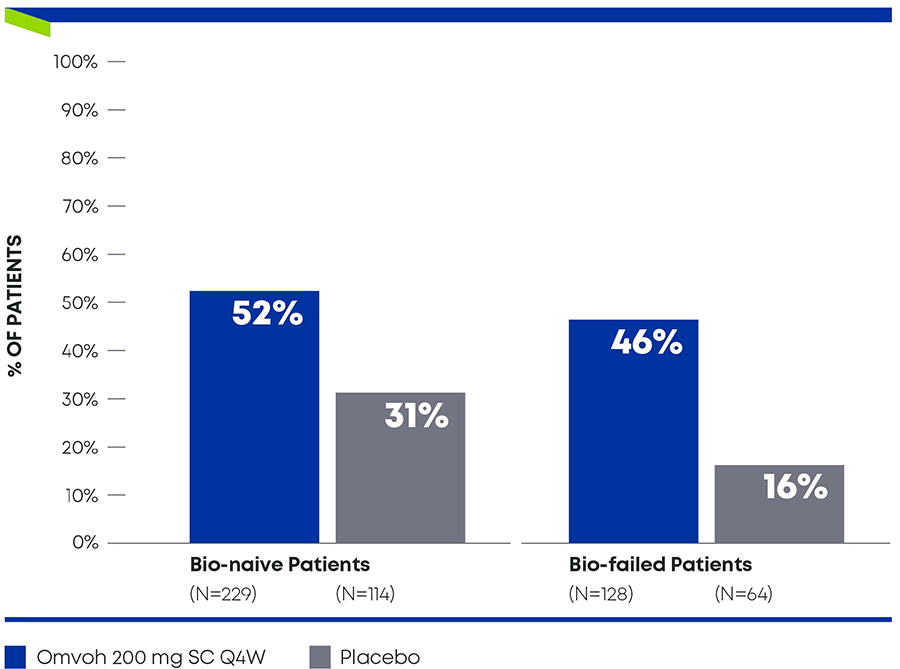
Omvoh demonstrated clinical remission regardless of biologic experience at Week 521
Bio-naïve and Bio-failed Patientsa Achieved Clinical Remissionb at Week 521
*Clinical response at Week 12 was defined as ≥2-point and ≥30% decrease in the MMS from baseline; RB subscore=0 or 1, or a ≥1-point decrease from baseline.1
- aBio-failed includes patients that did not respond or were intolerant to any of the following: TNF blockers, vedolizumab, or tofacitinib. An additional 1 patient on placebo and 8 patients on Omvoh were previously exposed to but did not fail a biologic or JAK-inhibitor. These patients were excluded from the bio-naïve/bio-failed subgroup analysis.1
- bClinical remission is based on the MMS and is defined as: SF subscore=0 or 1 with a ≥1-point decrease from baseline, RB subscore=0, and ES=0 or 1 (excluding friability).1
Bio-failed=Biologic-failed; Bio-naïve=Biologic-naïve; ES=Endoscopic Subscore; JAK=Janus kinase; MMS=Modified Mayo Score; Q4W=Every 4 Weeks; RB=Rectal Bleeding; SC=Subcutaneous; SF=Stool Frequency; TNF=Tumor Necrosis Factor.
1. Omvoh EUSPC FEB 2025.
Omvoh achieved and sustained clinical remission up to 4 years1
Efficacy at Week 212: OC of Week 52 remitters1,†
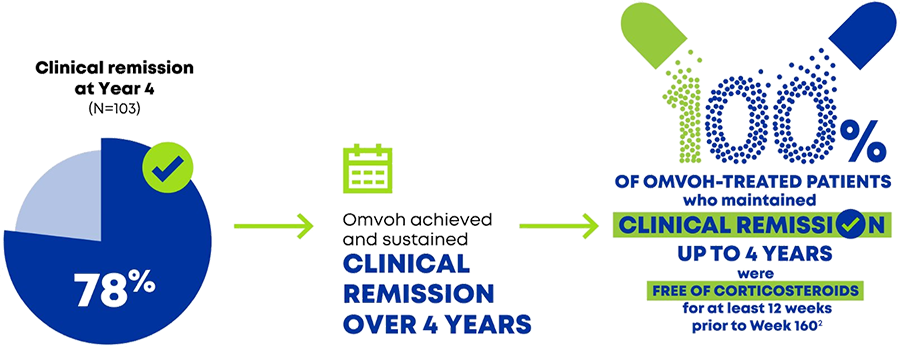
†Maintenance remitters: Induction responders who were then LUCENT-2 Week 40 (1 year of continuous Omvoh treatment) clinical remitters.2
Clinical remission: SF=0 or SF=1 with ≥1-point decrease in modified Mayo score from baseline; RB=0; and ES=0 or 1 (excluding friability).2
ES, endoscopic subscore; OC, observed case; RB, rectal bleeding; SF, stool frequency.
1. Data on file, Eli Lilly and Company. 2. Sands BE, et al. Inflamm Bowel Dis.2025;31(7):1876–1890.
Patients achieved clinical, endoscopic and BU remission, along with HEMR up to 4 years1,2
Efficacy at Week 212: mNRI and OC of Week 52 remitters1–2,†
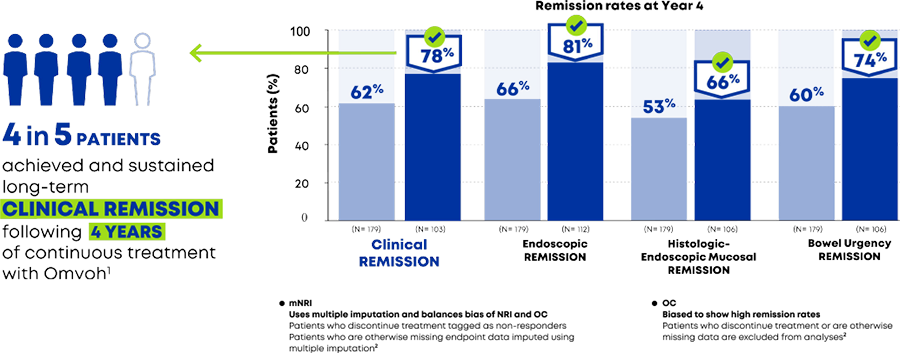
†Maintenance remitters: Induction responders who were then LUCENT-2 Week 40 (1 year of continuous Omvoh treatment) clinical remitters.2
Clinical remission: SF=0 or SF=1 with ≥1-point decrease in modified Mayo score from baseline; RB=0; and ES=0 or 1 (excluding friability). Endoscopic remission: ES=0 or 1 (excluding friability). Histologic endoscopic mucosal remission: Geboes ≤2B.0 + ES=0 or 1 (excluding friability); histologic remission with resolution of neutrophils, defined using Geboes scoring of ≤2B.0; Geboes subscores of 0 for grades: 2b (lamina propria neutrophils); 3 (neutrophils in epithelium); 4 (crypt destruction); 5 (erosion or ulceration). Bowel urgency remission: Urgency NRS=0 or 1.2
BU, bowel urgency; ES, endoscopic subscore; HEMR, histologic-endoscopic mucosal remission; (m)NRI, (modified) non-responder imputation; NRS, numeric rating scale; OC, observed case; RB, rectal bleeding; SF, stool frequency.
1. Data on file, Eli Lilly and Company. 2. Sands BE, et al. Inflamm Bowel Dis.2025;31(7):1876–1890.
Omvoh (mirikizumab) Significantly Improved Bowel Urgency As Early As Week 2 Vs Pbo, Sustained Up To 4 Years1–3
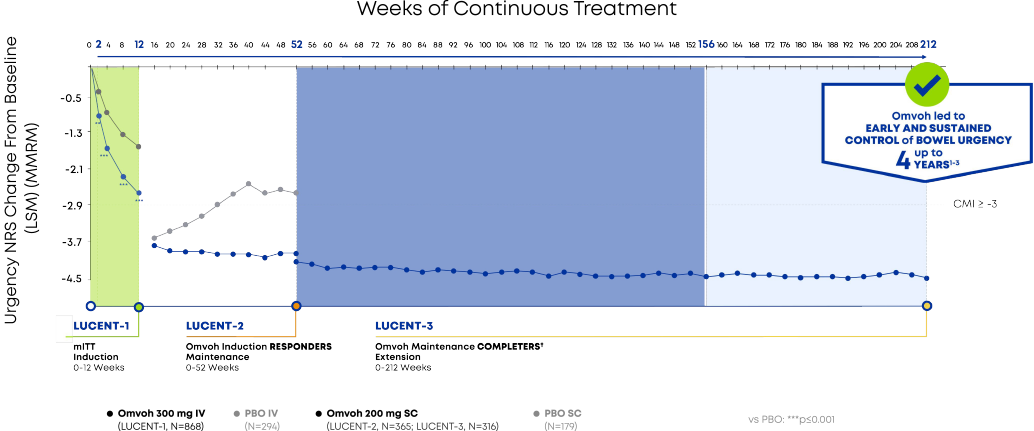
Analysis was completed for patients in the mITT population to estimate the mean change from induction baseline.
- † Patients who were induction responders and who moved into LUCENT-3.2
- MMRM was used for treatment comparison adjusting for baseline stratification factors. LSM were reported for each treatment group except for W0 of maintenance (W12 continuous treatment); no treatment comparisons in LUCENT-3.2
- Rectal bleeding severity: Change in RB MMS subscore from induction baseline.2
CMI, clinically meaningful improvement; IV, intravenous; LSM, least squares mean; mITT, modified intent-to-treat; MMRM, mixed-effect model of repeated measures; MMS, modified Mayo Score; PBO, placebo; RB, rectal bleeding; SC, subcutaneous; W, week.
1. Danese S, et al. J Crohns Colitis. 2024;18(11):1845–1856. 2. Sands BE, et al. Inflamm Bowel Dis. 2025;31(7):1876–1890. 3. Data on file, Eli Lilly and Company.